Some homes impress through their size, their materials or a photograph taken at exactly the right moment. Yet once a property is considered as a place to live, quieter and more decisive qualities come into view: light, orientation and views.
These are not secondary details. Light changes how rooms are perceived. Orientation influences how the home is experienced throughout the day. Views bring a sense of depth, calm and connection with the surroundings.
In an area such as the Guadalest Valley, where the landscape has a strong presence, these three qualities can alter the entire experience of a property. Anyone considering a house near Guadalest should therefore look beyond the first impression and ask a more meaningful question: how does the house feel once everyday life is imagined within it?
Why light matters more than a good photograph
A property can look bright in a photograph without feeling bright in daily use. One room may have been captured beautifully while internal areas remain subdued, transitions feel less comfortable or certain spaces depend too heavily on artificial lighting.
Natural light should not be judged by quantity alone. What matters is how it enters, where it comes from, which rooms benefit and how it changes the atmosphere as the day progresses.
Good light can make spaces feel more generous without adding a single square metre. It softens interiors, improves the relationship between rooms and creates a sense of ease that is difficult to communicate in a property listing. A bright home does not simply look better; it is experienced differently.
For that reason, a buyer looking for a house near Guadalest should not stop at asking whether the property receives plenty of light. The more useful questions are what kind of light it receives, when it appears and which parts of the home genuinely benefit from it.
Orientation: how a home relates to the course of the day
Orientation is often mentioned quickly, even though it deserves a more measured assessment. It is too simplistic to describe one orientation as universally good or bad. Every property needs to be understood in relation to its exact setting, layout, openings, outdoor areas and the way its future occupants intend to live.
For a home used occasionally, particular moments of the day may matter most. In a house intended for longer stays or more permanent living near Guadalest, orientation carries greater weight because it affects everyday comfort, the use of outdoor areas and the relationship between living and sleeping spaces.
When orientation is well resolved, the home develops a rhythm. It does not feel the same in the morning, at midday or towards the end of the afternoon. Light moves, shadows change and different rooms take on importance at different times.
A viewing should therefore allow time for observation. It is not only a matter of noting where the sun is, but of understanding how the living room, kitchen, bedrooms, terraces and garden behave. A well-balanced orientation rarely needs an elaborate explanation; it is often something that can be felt.
Views: not only landscape, but space and calm
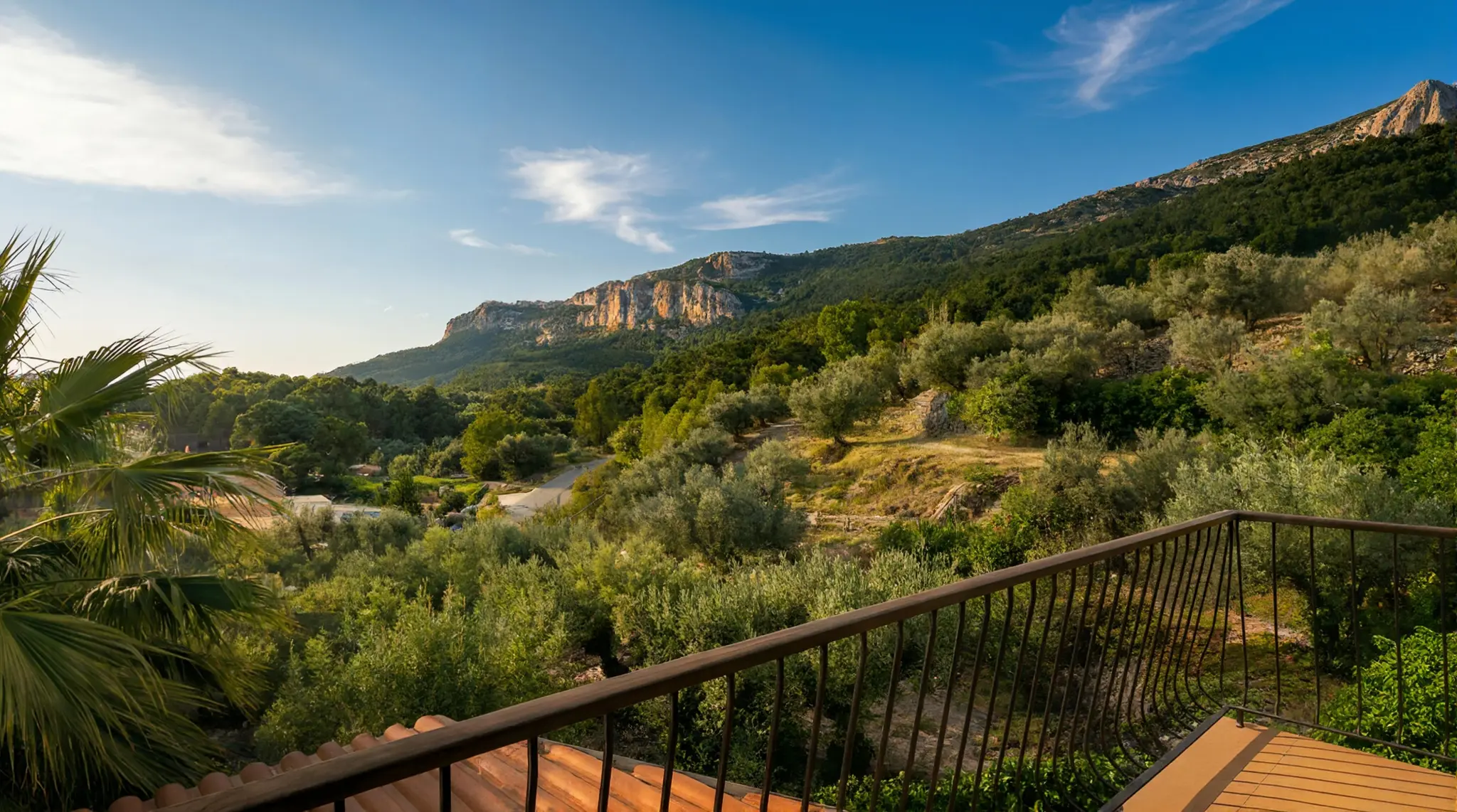
Views are one of the attractions of a home in the wider Guadalest area, but they deserve closer scrutiny than they are often given. Not every outlook contributes in the same way. A pleasing angle from one window or an attractive terrace photograph is not enough on its own.
Views matter when they become part of daily life: when they accompany breakfast, reading, conversation, a quiet afternoon or the simple act of opening a window.
A considered outlook can give a room greater depth. It does not increase the built area, but it changes how that area is perceived. The interior seems to breathe more freely, the boundary of the home moves towards the landscape and the property gains a broader horizon.
This is especially relevant for someone seeking a property with views in the Guadalest Valley. The landscape should not operate merely as an external backdrop. Ideally, it should be a natural presence that accompanies the home without overwhelming it.
The relationship between indoors and outdoors
Light, orientation and views make most sense when considered together. A house may have generous windows without a fluid relationship with the outside. It may have a terrace that feels disconnected from the interior, or a garden that plays little part in everyday use.
The essential quality is continuity between indoors and outdoors. When the living room opens naturally towards a terrace, the kitchen relates comfortably to an outside area, or the garden remains present from the principal rooms, the home begins to work in a different way.
In a house with land near Guadalest, this continuity can be one of the property's most meaningful qualities. The exterior stops feeling like an addition and becomes part of domestic life.
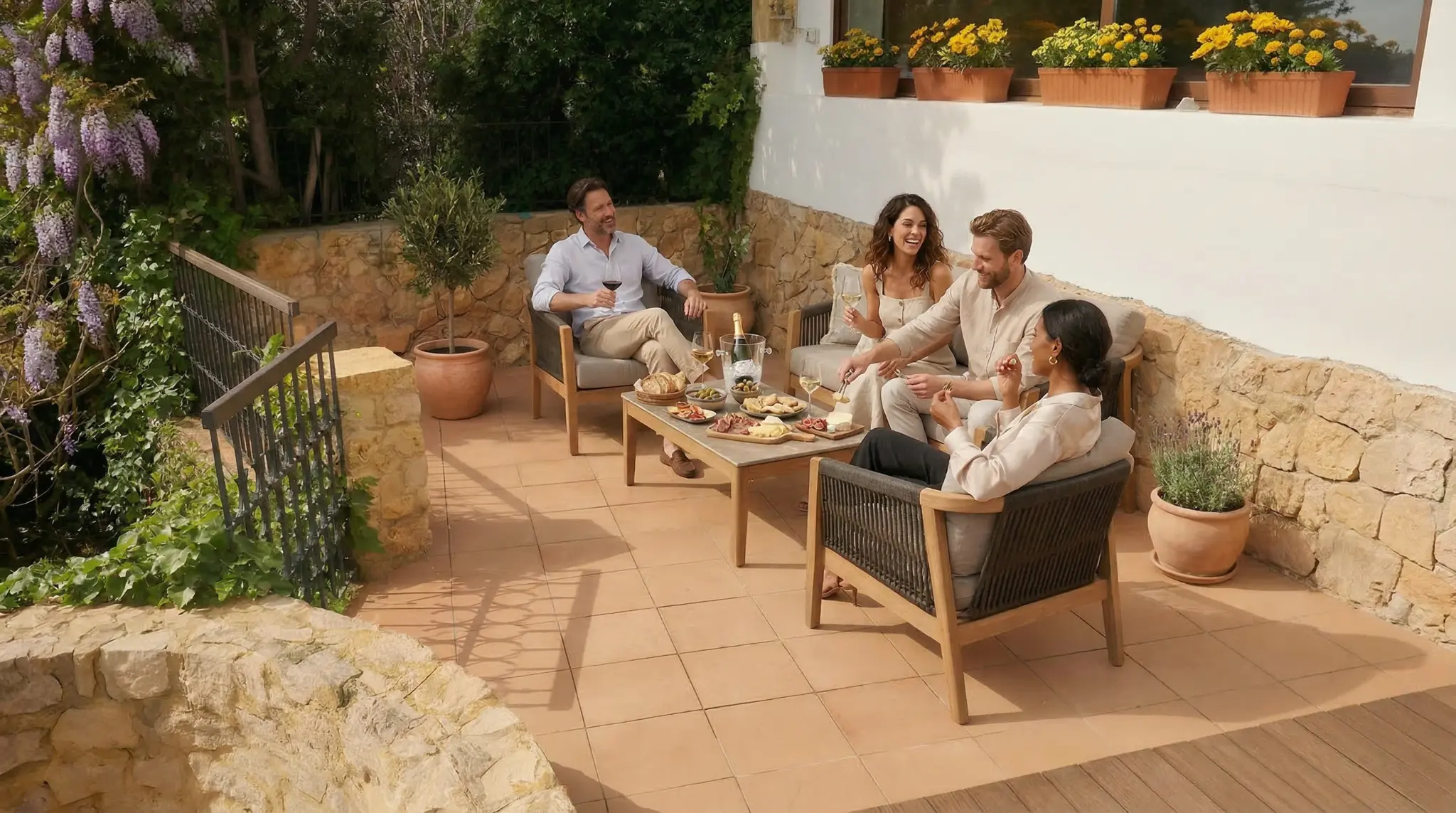
This does not mean promising permanent outdoor living. It means that the house offers possibilities: resting outside, receiving visitors, looking towards the landscape, reading quietly, sharing a meal in a pleasant setting or simply feeling that the home does not end at its walls.
Visual privacy: opening to the landscape without feeling exposed
Privacy is one of the more subtle questions in a home with views. It is sometimes assumed that openness to the landscape must come at the expense of intimacy. That need not be the case.
Visual privacy does not mean shutting the house away. It means enjoying light, outdoor space and views without feeling that everyday life is overly exposed. Position, orientation, planting, changes in level, nearby routes, neighbouring properties and possible viewpoints all influence this balance.
In a house offering privacy near Guadalest, a buyer should observe not only what can be seen from the property, but also from where the property itself can be seen. The distinction matters.
A terrace may look appealing but feel uncomfortable if it is too exposed. A living room may have wide openings yet lose intimacy if it faces a frequently used area. A garden may appear spacious while offering few sheltered places in which to spend time.
Good privacy is not always obvious in an initial photograph. It becomes clearer during a viewing, by walking through the grounds, looking from inside to outside and then reversing that perspective.
What to observe during a viewing
Assessing light, orientation and views requires more attention than a quick walk through the rooms. It is worth pausing, observing and asking specific questions:
- Which rooms receive the most useful natural light?
- Does the light reach the areas where daily life actually takes place?
- Are the views present from the principal rooms or only from secondary positions?
- Do the terrace and garden connect comfortably with the house?
- Are there outdoor areas that invite use rather than simply observation?
- Does the property feel open to the landscape without losing intimacy?
- Does the orientation appear consistent with the intended use of the home?
Questions like these help distinguish a photogenic property from a genuinely liveable one. The first may impress within minutes. The second continues to make sense once everyday life has been imagined inside it.
Villa Las Higueras as an example of considered observation
Villa Las Higueras can be approached from this perspective: not simply as a property in the Guadalest Valley area, but as a home whose relationship between light, land, views and daily life deserves to be observed.
During a viewing, the useful exercise would not be limited to checking general facts. It would involve understanding the property as a whole: the impression created on arrival, the way the interior spaces feel, how the house relates to the outside, which areas offer the greatest calm and how the landscape accompanies daily experience.
This matters particularly to someone seeking a distinctive house near Guadalest. The decision should not rest solely on whether the property is attractive. It should also consider whether it offers a way of living that suits the setting: greater calm, a sense of space, visual privacy and a more natural connection with the landscape.
Villa Las Higueras does not need to be described through exaggeration. It should be considered calmly, through the qualities that matter when a house stops being an image and begins to be imagined as a place to live.
Conclusion
Light, orientation and views may seem intangible, but their effects are very real. They change how a room is perceived, how a terrace is used, how private a property feels, how the garden relates to the interior and how the home is experienced every day.
When considering a property near Guadalest, it is therefore worth looking beyond floor area, photographs and sales descriptions. A house should be observed slowly: how light enters, how it opens towards the landscape, how it protects intimacy and how it supports ordinary life.
Sometimes the distinction between an adequate property and a special one cannot be found in a technical figure. It lies in something harder to measure, but more important: how the home feels when you imagine living there.